These are navigation links to move inside this page.


Global Navigation









In the summer of 2003, Konica Minolta not only introduced
the fourth generation of the DiMAGE 7 series with the DiMAGE A1, but also
introduced a completety new system for image stabilisation. In contrast to the
conventional optical image stabilising systems, Anti-Shake does not use movable
optical elements to compensate for camera shake, it compensates for it by
shifting the CCD.
In our first article about Anti-Shake we have introduced
the basic advantages of the system. In the following, we want to give you an
insight in the complex technology that is necessary for realising such a
system.
| |||
| |||
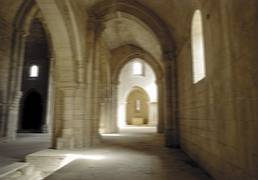
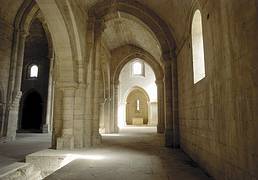
Left: No Anti-Shake - Right: Anti-Shake |
|
|
|
An old rule of thumb for photographers states that the
longest shutter release time that can be used for sharp exposures without a
tripod is the reciprocal value of the focal length (SI focal length). The DiMAGE
A1 has a maximum focal length of 200 mm, the maximum shutter release time thus
is 1/200 seconds. When releasing for longer durations, the image will be shaky
and blurry.
With the Konica Minolta Anti-Shake system the camera is capable
of detecting the movement of the camera and shifting the CCD in a way, that
compensates for the movement of the camera in the duration of the exposure. This
way, the exposure can take up to 8 times longer (3 clicks), than when shooting
without Anti-Shake.
For a focal length of 200 mm, this means that photos with a shutter release time of 1/60 seconds can be taken, without loosing sharpness. This, on the other hand, means, that Anti-Shake has not only to be able to detect the movement of the camera in 1/60 seconds (0,017 seconds), but that it also has to calculate the necessary compensation and to shift the CCD exactly the calculated value.
|
 |
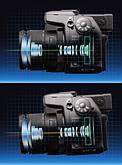
The movement of the camera is acquired with the help of two gyroscope-sensors.
It is not only necessary to detect the angle of movement,
but also the speed of it. The signal generated by the sensors measuring the
angle of the camera is passed on to a microprocessor. The microprocessor is
getting additional data about the position of the CCD-mount from a
position-sensor. The data is passed on to the Anti-Shake processor, that
calculates the exact movement that is necessary to compensate for the camera
shake.
The whole process is happening several times in an exposure time of
1/60 seconds.
|
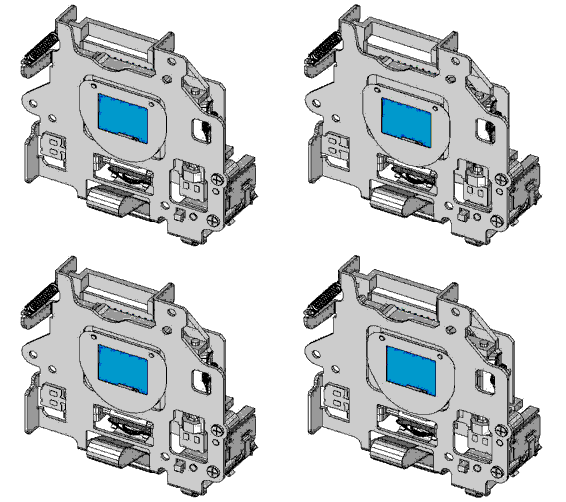 |
The CCD-mount is moved by piezo-motors, that have been
developed especially for the Anti-Shake-System.
The CCD-mount has to be moved extremely fast and precisely to be able to counteract the camera movement. Regular electro-motors would be much too slow for this task, furthermore they would be too large and inaccurate. For that reason, for Anti-Shake the SIDM (Smooth Impact Drive Mechanism) has been developed. The SIDM uses a piezo-element that is, despite its extreme compact size, able to move the CCD mount fast and accurately.
The working-principle of piezo-elements is known from electronic lighters. If a piezo-element is exposed to pressure, a voltage arises. Electronic lighters use this voltage to generate the lighting spark.
But the effect can also be used the other way
round:
If a voltage is applied to a piezo-element, it expands. If the voltage
is withdrawn, it contracts to its normal size. The CCD-mount is shifted by
expanding piezo-elements. If the piezo-element is contracting, the CCD-mount
stops moving. To move the CCD-mount in the opposite direction, another
piezo-element is necessary. This mechanism makes extreme and accurate shifting
of the CCD-mount to the correct position feasible.
|
 |
The operational range of conventional image stabilisation
systems is located in a frequency-range between 1 and 15 Hz (oscillation). It is
mainly dimensioned for large focal lengths, because in this case only small
movements have to be compensated for. When having to deal with slower and larger
movements, for example 1 to 2 Hz, the reaction time of this systems is
comparatively high.
The Anti-Shake-system is able to work fast and
effectively starting with a frequency of approximately 0,5 Hz, because it is
able to move the CCD in relatively large distances. Thus the Konica Minolta is
also suitable when using short focal lengths.
The Anti-Shake-system not only improves the sharpness of the pictures, it also makes it possible to choose a lower ISO-sensitivity for example. Like in analogue photography, the image quality is higher when using lower ISO-sensitivities.
When shooting with flash slow-sync, the Anti-Shake system
can be of great help to the photographer. In many cases it is actually possible
to work completely without a flash and to capture the natural mood of light
without the sometimes disturbing artificial light.
Because the system is
working completely in the background, the photographer is able to focus entirely
on the subject.
| ||
 |
|
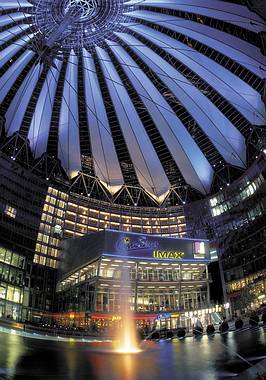 |
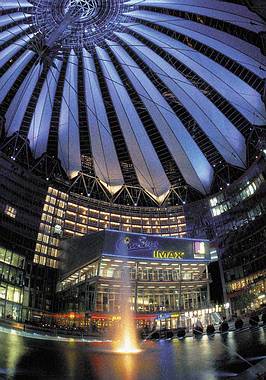
Left: Anti-Shake deactivated - Right: Anti-Shake activated | ||
The Konica Minolta Anti-Shake-system enables the photographer to make exposures that were previously not possible.

 Knowledge Base
 Colour temperature: the degree of Kelvin is
decisive
And Action – movies with DiMAGE
cameras
Zone matching with the Dynax 5D
Flashes – basic knowledge
Basic knowledge of flash photography – Part
2
„Physics of noise“ – an introduction
The basic principles of a camera
Image formation with a lens
Megapixel
Power supply of a camera
Memory cards
The optical view-finder
Autofocus-systems
Colour temperature: the degree of Kelvin is
decisive
And Action – movies with DiMAGE
cameras
Zone matching with the Dynax 5D
Flashes – basic knowledge
Basic knowledge of flash photography – Part
2
„Physics of noise“ – an introduction
The basic principles of a camera
Image formation with a lens
Megapixel
Power supply of a camera
Memory cards
The optical view-finder
Autofocus-systems
 Anti-Shake
 technology
Real-Time Histogram
Focal length magnification
CCD vs.
CMOS
Anti-Shake
Anti-Shake technology
Real-Time Histogram
Focal length magnification
CCD vs.
CMOS